
 Free delivery in Ukraine upon full payment of the order
  Return of goods within 14 days

What is the 'slouchy' silhouette and why it's more than just jeans
In the world of fashion, where trends replace each other with kaleidoscopic speed, there are directions that stay with us for a long time, transforming from a fleeting hobby into a full-fledged philosophy. One of them is the pursuit of comfort, which gave us the so-called 'slouchy' silhouette. Initially, this term was strongly associated with jeans — loose in the hips, slightly baggy, and tapered towards the ankle. However, today the slouchy philosophy has gone far beyond denim. It is an entire concept of relaxed, yet thoughtful cut, which can be found in dresses, trousers, sweaters, and even jackets. It is a story about freedom of movement, self-confidence, and a new understanding of elegance that requires no sacrifices.Dresses, jumpsuits
This trend did not emerge from nowhere. Its roots can be traced through different eras: from the loose flapper dresses of the 1920s, which rejected corsets, to the voluminous 'power suits' of the 1980s, which gave women a sense of power, and the grunge layering of the 1990s. Today's wave of slouchy popularity is largely due to a global re-evaluation of values, especially after the pandemic, when home comfort became a priority. We realized that clothing can and should be comfortable, without losing style. The main challenge posed by voluminous cuts is the risk of losing the figure's contours, turning the look into something shapeless. But this is precisely where the art of styling lies: not to hide oneself behind fabric, but to build a new, interesting architecture of the look. It's about a delicate balance between volume and structure, relaxation and composure. In this article, we will analyze how to master loose silhouettes, learn to play with proportions, and create harmonious and elegant everyday outfits.
Geometry of Comfort: Deconstructing the DNA of Loose Fit
At the heart of any 'slouchy' silhouette lies the idea of intentionally increasing volume in certain areas. This is not just clothing several sizes larger, but carefully constructed items. Designers use techniques such as dropped shoulder lines, 'batwing' or 'dolman' sleeves, wide palazzo trousers, A-line or cocoon-shaped cuts for dresses and coats. All these elements create a feeling of lightness and ease. Such clothing does not cling to the body but delicately drapes around it, creating intrigue, emphasizing the dynamics of movement, and leaving room for imagination. This is clothing that is comfortable to live in — from morning coffee to an evening stroll.
Material plays a key role in creating the correct voluminous silhouette. The fabric should be pliable enough to drape beautifully and form soft folds, yet possess sufficient density to hold its shape. Stiff and thick material in a voluminous cut will create a bulky, clumsy look. Natural and semi-synthetic materials with good drape are ideal:
- Cotton and staple fiber:Light, breathable, and hygroscopic, they are ideal for summer dresses and shirts. They create soft, natural folds. For example, dresses made of 100% cotton provide that very balance between form and freedom, which is the essence of slouchy style. They do not hang like a sack but create a lively, dynamic contour.
- Linen:It possesses a unique texture and wrinkles beautifully, which adds a noble relaxedness to the look. Linen palazzo trousers or a loose shirt are classics of the slouchy wardrobe.
- Silk, viscose, Tencel:These flowing materials create an airy, delicate silhouette. They are ideal for blouses, slip dresses worn under a voluminous sweater, and wide trousers.
- Fine wool and cashmere:For the cold season, there is nothing better than a voluminous sweater or cardigan made of quality knitwear. It softly envelops the figure, warms, and looks very cozy and expensive.
Playing with Proportions: How Not to Get Lost in Volume
The biggest fear when choosing voluminous clothing is looking larger than you actually are. But this is easy to fix if you know a few simple rules for working with proportions. The main task is to create visual 'anchors' that will structure the silhouette and remind of the figure's contours beneath the loose fabric.Jumpsuits
Focus point: emphasizing the waist, shoulders, and delicate areas
Even if your dress or sweater doesn't have a defined waistline, it can and should always be created. This instantly structures the look.
- Belt:The most obvious way. Thin or wide, leather or textile — it will instantly gather the silhouette and make it more feminine.
- Top layer:A cropped jacket, a denim jacket, or even a shirt tied at the waist will create the necessary horizontal line, visually narrowing the midsection and balancing a voluminous bottom.
- «French tuck»:Tuck the front part of your sweater or shirt into your trousers or skirt, leaving the back and sides loose. This technique defines the waist without disrupting the overall relaxed feel of the look.
- Cross-body bag:The bag strap, running diagonally across the torso, also creates a line that visually «gathers» the figure.
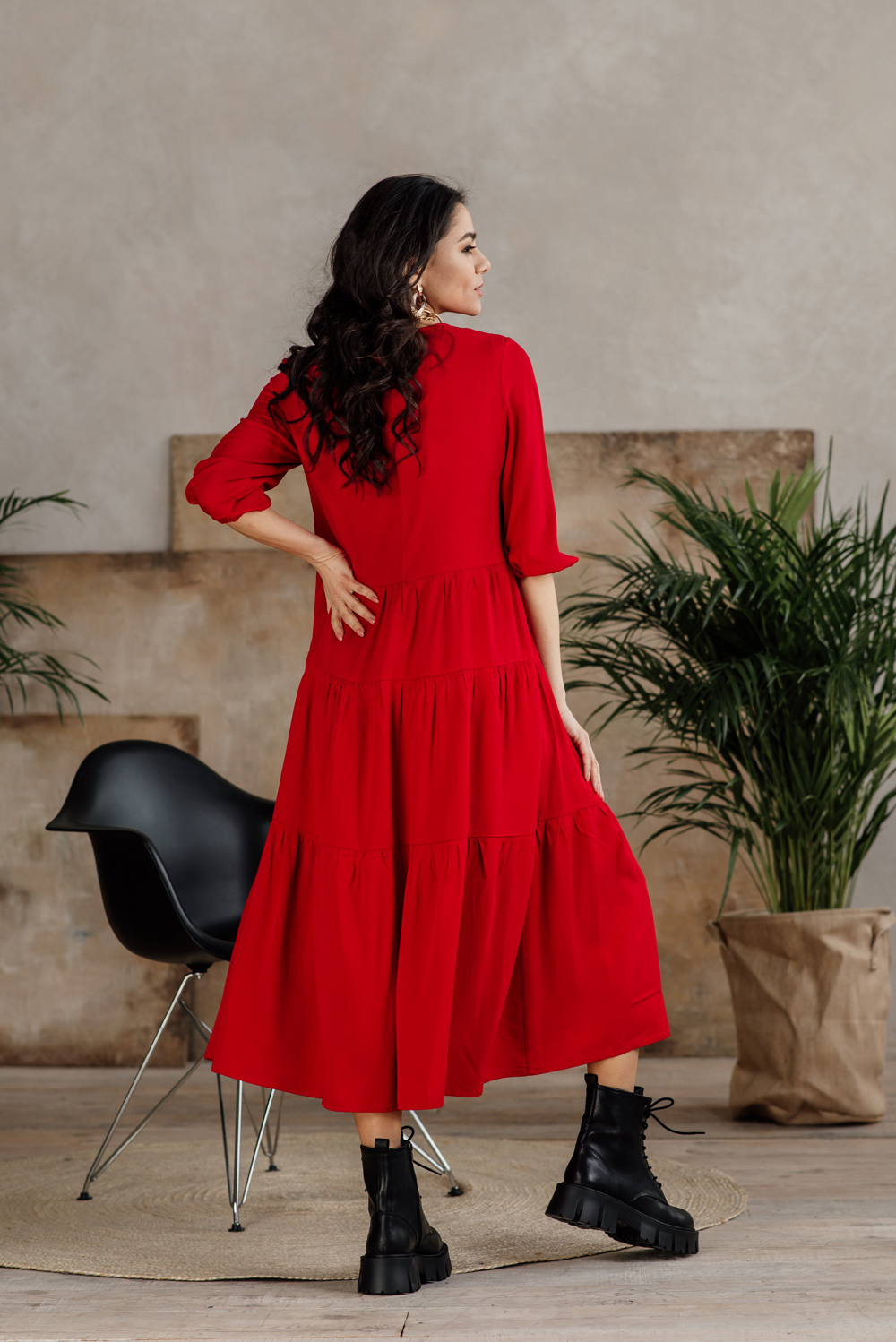
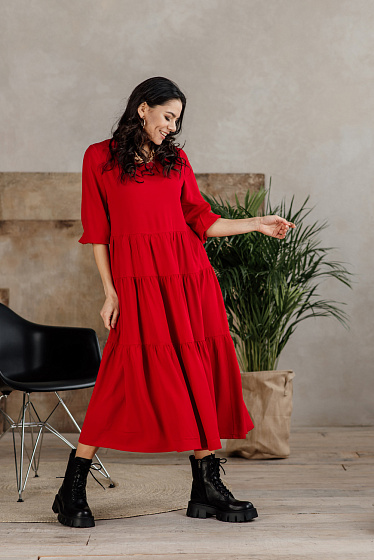
It is equally important to pay attention to the thinnest parts of the body. Exposed collarbones, an elegant neck, slender wrists, and ankles are details that, in contrast to volume, add fragility to the look. Choose dresses with a round or V-neckline. Roll up the sleeves of sweaters and jackets. For example,Red midi dress with ruffles, thanks to its loose fit and ¾ sleeves, delicately reveals the wrists, which, in combination with the volume of the main part, creates a beautiful contrast. This is a case where a small detail completely changes the perception of the look.
Vertical and length: choosing the right footwear and color
Footwear is your main ally in building correct proportions. With voluminous clothing, it acts as a foundation that either weighs down the look or, conversely, makes it light and upward-striving.
- Open instep and pointed toe:To visually elongate the silhouette, prefer footwear that exposes the instep or has a pointed toe. These can be pumps, ballet flats, mules, or sandals.
- Platform or heeled footwear:Additional centimeters of height always help balance voluminous clothing.
- Sneakers and trainers:For a relaxed look, they will suit, but it's better to choose not too massive, laconic models, so as not to "nail" the silhouette to the ground.
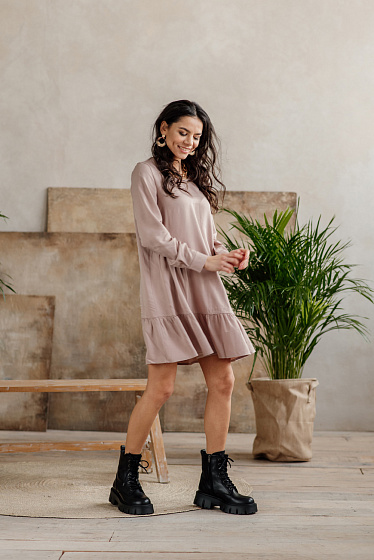
The length of the product itself also matters. If you are short, avoid the dangerous mid-calf length, which can visually "cut" the legs. Your choice is either mini, like withCotton dress with puff sleeves, which reveals the legs and makes the silhouette lighter, or floor-length maxi, which creates a single vertical line. It is important that there remains visible space between the hem and the shoes — an open ankle works wonders with proportions.Sportswear
Another powerful tool ismonochrome. An outfit assembled in one color or in close shades creates a continuous vertical line that slims and elongates the figure, even if all items in it are voluminous.
Stylistic scenarios: from office to walk
The charm of loose silhouettes lies in their versatility and adaptability. The same item can look completely different depending on the context and accessories.
Everyday chic
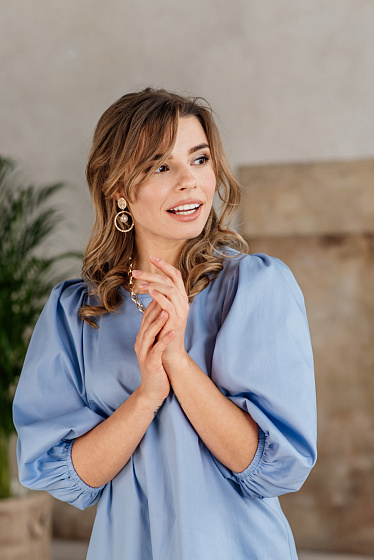
For a daytime stroll around the city or a meeting with friends, a loose-fitting dress made of natural fabric is ideal. Imagine a light spring day, you are sitting on a cafe terrace, and the ruffle on the hem of your dress sways in the wind. This is exactly the mood created by, for example,Blue spring dress. Complement it with white sneakers, a woven bag, and sunglasses — and a comfortable, yet stylish look is ready. Another option: wide linen trousers, a basic t-shirt tucked in at the front, and sandals.
Business elegance
Can a voluminous dress or trousers be incorporated into a strict dress code? Absolutely. The secret is in quality fabrics, restrained colors, and structured additions. Choose models with a minimalistic cut. For example, combine wide trousers made of suit wool with a silk blouse and a strict straight-cut jacket that will "gather" the shoulders. Complement a loose shirt dress with classic loafers, a waist belt, and a structured tote bag. In this form, loose clothing ceases to be exclusively a relaxed wardrobe item and transforms into the basis of an elegant and modern business look.In Ukrainian
Evening out
An evening out is another reason to turn to voluminous silhouettes. An A-line dress made of satin or wide palazzo trousers made of velvet look elegant on their own. It is enough to add elegant sandals with thin straps, a small clutch, and a pair of noticeable earrings to get a look that will be both festive and incredibly comfortable. You will be able to enjoy the evening without thinking that the clothes are pulling somewhere or restricting movement. An oversized jacket worn on a bare body as a dress is a bold and relevant option for a party.
Accessories as architectural elements
When working with voluminous items, accessories cease to be mere decorations and become full-fledged tools for shaping the silhouette. They help to set accents, add structure, and complete the look.
- Bags:With a voluminous dress or coat, small, clearly defined models look best: a cross-body bag on a long strap, a baguette bag, or a rigid clutch. They create a contrast of shapes and do not overload the look. A large and soft tote bag, on the contrary, can enhance the feeling of shapelessness, so it is better to combine it with more structured outfits.
- Jewelry:They also play an important role. A long chain with a pendant will create an additional vertical that will visually elongate the silhouette. Large, sculptural earrings or a necklace will draw attention to the face and neck, distracting from volume in the lower body. Several thin bracelets will emphasize a delicate wrist.
- Scarves and shawls:The way you wear a scarf can change proportions. Casually draped over the shoulders, it will add a horizontal line, while tied with long ends down, it will emphasize the vertical.
Main mistakes and how to avoid them
- The "tent" effect:Combining several very voluminous items without a single accent.Solution:Always maintain balance. If you have a voluminous top (sweater), let the bottom be narrower (skinny jeans, a straight skirt). If you wear wide trousers, it is better to make the top more concise or emphasize the waist.
- Wrong fabric:Using stiff, standing fabrics that do not drape.Solution:Choose pliable, flowing materials that will move with you.
- Ignoring scale:Especially relevant for petite women. Too much volume can "swallow" the figure.Solution:Choose items with moderate oversized fit, look for models in petite lines of brands, and always expose your ankles and wrists. Monochrome looks will also work for you.
- Untidy appearance:Relaxed does not mean sloppy.Solution:Make sure your clothes are clean and ironed (unless it's linen, which looks good wrinkled). Complete the look with a neat hairstyle, makeup, and well-groomed shoes. These details distinguish a well-thought-out slouchy look from a simple "threw on whatever".
Checklist: How to embrace the voluminous silhouette
- Create a waist focus:use a belt, a "French tuck", or a cropped top layer to define the narrowest part of the figure.
- Expose graceful body parts:don't hide wrists, ankles, and collarbones — this will add fragility to the look.
- Choose the right footwear:prefer models that lengthen the leg (pointed toe, open instep) and do not weigh down the look.
- Play on contrast:combine soft, voluminous fabrics with rigid, structured accessories (bag, belt).
- Mind the length:choose mini or maxi length so as not to "cut" the figure's proportions, especially if you are short.
- Utilize the power of monochrome:outfits in one color visually lengthen and slim.
Ultimately, the fashion for loose silhouettes is not about hiding, but about feeling confident and comfortable in your own body. It's an opportunity to create complex, multi-layered, and intellectual looks that reflect your individuality. It's quiet luxury and the freedom to be yourself. Don't be afraid of volume — learn to manage it, and it will become your main fashion ally.