
 Free delivery in Ukraine upon full payment of the order
  Return of goods within 14 days

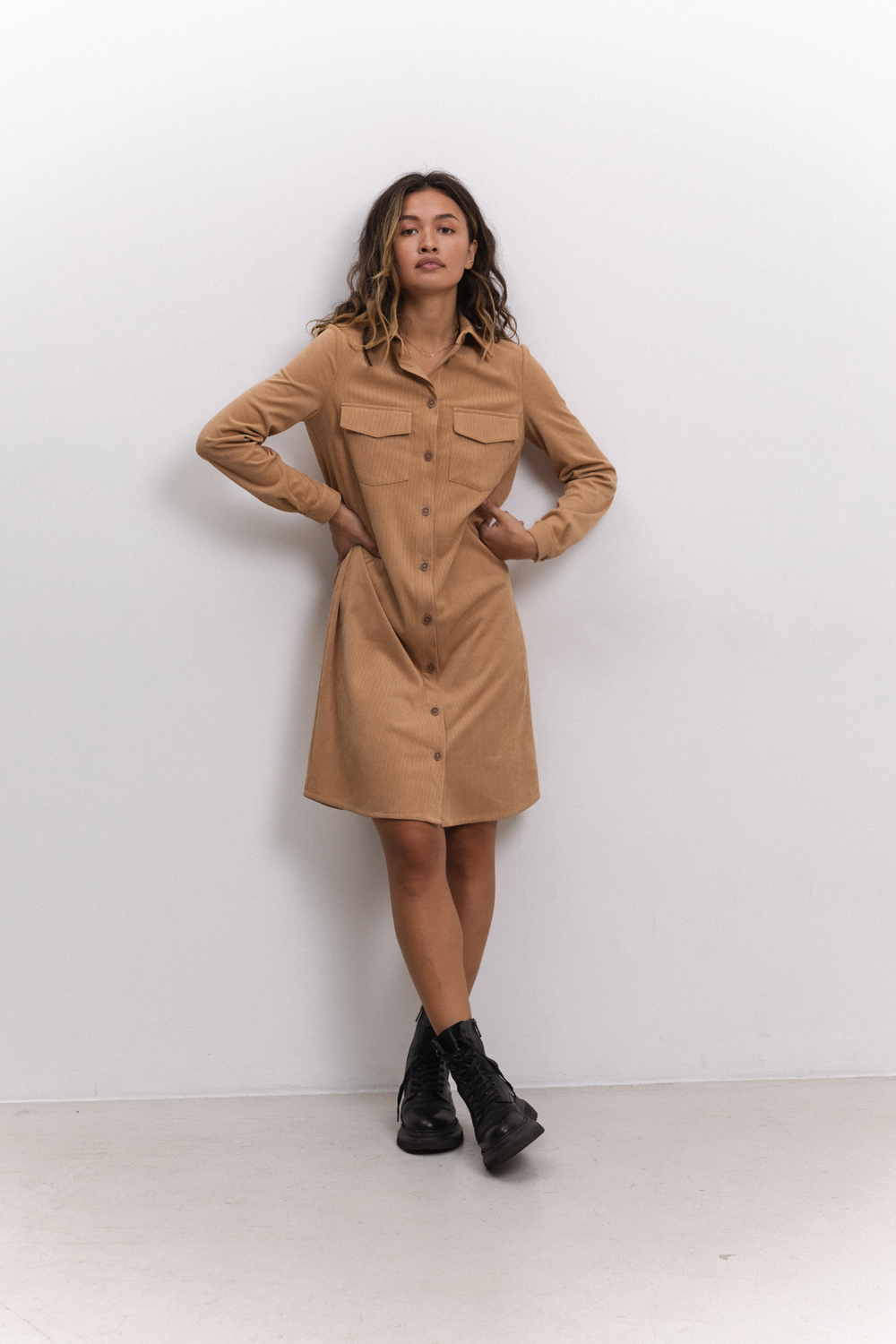
Warm Office: How to Wear a Corduroy Shirt Dress and Sundress in Layered Looks
With the onset of cold weather, the morning dilemma of “what to wear to the office” escalates to the level of a strategic task. One needs not only to look professional, stylish, and adhere to the dress code, but also to solve an equation with several unknowns: not to freeze on the way to work, not to overheat in a heated room, and to maintain an elegant silhouette under several layers of clothing. The task seems almost impossible, but there is a solution, and it lies in the art of thoughtful layering. This is not about bulky sweaters, but about elegant combinations of textured fabrics, such as corduroy and wool, with thin but warm base layers. A well-chosen corduroy shirt dress or a warm sundress can become the foundation of a comfortable and impeccable wardrobe for the entire cold season.Dresses, Jumpsuits
Layering is not just a piling up of clothes. It is a well-thought-out system that allows you to adapt to temperature changes throughout the day, ensuring comfort and functionality. Leaving home on a frosty morning, you feel protected from the cold, and upon arriving at a warm office, you can remove the top layer or simply feel comfortable in a light but warm combination. This approach allows the same outfit to work in different conditions, eliminating the need to sacrifice style for warmth. In this article, we will analyze how to create such looks, what fabrics to choose, and how to combine them to maintain an elegant silhouette and business style.
Why corduroy is the ideal fabric for an autumn-winter wardrobe?
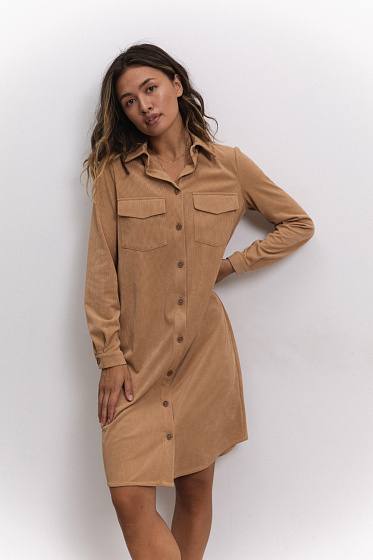
When we think of fabrics for the cold season, wool, tweed, and cashmere immediately come to mind. However, corduroy deserves no less, and sometimes even more, attention, especially in the context of modern office fashion. This fabric with its characteristic longitudinal rib possesses a unique set of qualities that make it indispensable.
Firstly, corduroy has excellent heat-retaining properties. It is dense enough to retain warmth well, but not as bulky as, for example, chunky knit or thick tweed. This allows for structured but not cumbersome silhouettes, which is critically important for a business wardrobe. Secondly, corduroy adds depth, nobility, and tactile comfort to an outfit. Its velvety texture plays differently in the light, making even the simplest cut interesting and multifaceted. Unlike smooth and strict suiting fabrics, corduroy brings a touch of softness, which is especially valuable on grey and cold days. Sometimes it's enough to just run your hand over the fabric to feel this pleasant warmth and comfort.
It is also worth noting the versatility of corduroy depending on the width of the wale. Pinwale corduroy with very thin stripes looks restrained and elegant, almost like velvet, and fits completely even within fairly strict business casual frameworks. Standard and wide-wale corduroy has a more relaxed, bohemian character, but in the right cut and color, it can also be appropriate in a creative or informal work environment.
Corduroy shirt dress: a versatile base for an outfit
A shirt dress is one of the most functional and versatile items in a woman's wardrobe, and a corduroy model elevates it to a new level of practicality for the cold season. Its main advantage is incredible variability. Such a dress can be worn as a standalone item, complemented with opaque tights and ankle boots, or used as the central part of a complex layered ensemble.
It is in layering that the corduroy shirt dress reveals its maximum potential. It can be worn over a thin turtleneck or long-sleeve top, creating a warm, cozy, and stylish look. If the top buttons are unbuttoned, the collar of the bottom layer will be visible, which will add thoughtfulness and structure to the outfit. In a more informal setting or as a third layer, it can be worn completely unbuttoned, like an elongated jacket or cardigan, over trousers and a top. This multifunctionality allows the same dress to serve different purposes and adapt to different situations, from a business meeting to a Friday dinner with friends.Jumpsuits
As an example, considerthe model from the selection. Its neutral, warm shade easily combines with most basic colors — from white, black, and grey to deep burgundy, emerald, or dark blue. The straight cut and functional pockets make it comfortable for everyday wear, while the noble corduroy texture gives it the elegance necessary for the office.
How to choose the “bottom layer”: turtlenecks, long-sleeve tops, and shirts
Choosing the right bottom layer is key to a successful, comfortable, and stylish layered look. It should be thin enough not to create extra bulk under the dress, and made of a smooth fabric so as not to “catch” on the corduroy and restrict movement. Let's consider the main options and their features.
- Turtleneck or golf.This is a classic, the warmest and most elegant option. A thin cashmere, merino, or viscose turtleneck is ideal for a corduroy dress or pinafore. A high collar not only protects the neck from cold but also creates a beautiful vertical line, visually elongating the silhouette. Choose basic colors (black, white, beige) for versatility or use the turtleneck as a color accent.
- Long-sleeve top with a round neckline.A simpler and more casual option. It will be almost unnoticeable under a dress with a fastened collar but will provide an additional layer of warmth. It is better to choose models made of high-quality cotton with added elastane or modal so that they fit well and are pleasant to the body.
- Classic shirt or blouse.Combining a shirt under a shirt dress or pinafore creates an interesting and slightly strict preppy-style look. Here it is important to ensure that the collars do not clash with each other. It looks best when the collar of the inner shirt, made of thin fabric (cotton, silk), neatly peeks out from under the unbuttoned collar of the dress. A blouse with a bow or interesting cuffs will add femininity and romanticism to the look.
When choosing an underlayer, it is important to find a balance. If you work in a very warm office, it might be worth choosing a light cotton long-sleeve top or a silk blouse. If the room is cool, a thin wool turtleneck will be more appropriate. This is the main advantage of layering — the ability to adapt to personal feelings and environmental conditions.
Warm Pinafore: An Elegant Alternative for the Office
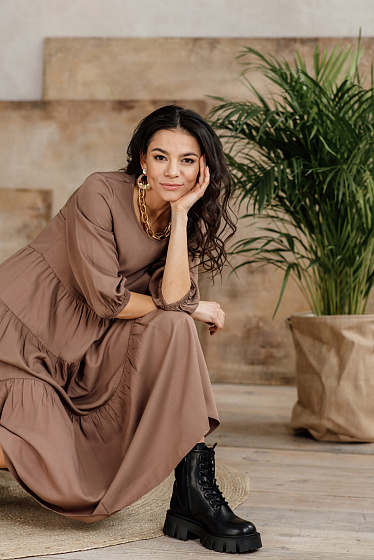
If a corduroy shirt dress is a versatile soldier, then a warm pinafore is a sophisticated tool for creating thoughtful and structured business looks. Unlike a dress, a pinafore inherently implies the presence of an underlayer, making layering not an option but a mandatory element. This immediately sets the tone for creating a more put-together and complete ensemble.
Warm pinafores for the office are usually sewn from dense suiting fabrics, tweed, wool, or the same corduroy. They can have different cuts: from straight and laconic to A-line, wrap models, or a sheath pinafore. You can wear almost any blouse, shirt, or turtleneck under a pinafore, getting a completely new look each time. For example, a gray tweed pinafore with a white silk blouse will look very dressy and formal. The same pinafore with a black cashmere turtleneck will create a cozier and more casual, yet no less elegant, ensemble. A V-neck pinafore is ideal for showcasing interesting blouse collars, and a square neckline pairs perfectly with minimalist turtlenecks.
Combining Textures: Rules for Harmony Without Excess Volume
The main secret of a successful layered look is the correct and harmonious combination of textures. It is the play on the contrast of smooth and textured that allows the ensemble to be visually interesting but not overloaded. Here are a few simple rules to help avoid mistakes.Sportswear
Rule #1: One Dominant Texture.Let one textured item be the main accent in the look — for example, a corduroy dress. All other elements should be as smooth and minimalist as possible. Thin knitwear (cashmere, merino), smooth cotton, silk, satin, or viscose will be ideal companions for corduroy, emphasizing its depth rather than clashing with it.
Rule #2: Avoid Two Bulky Items.It is not advisable to wear a thick knitted sweater under a dense corduroy dress or a textured flannel shirt under a tweed pinafore. This will inevitably add a few extra centimeters to the waist and shoulders and make the figure bulky. The principle of 'warmth without bulk' is achieved through the density and quality of materials (for example, thin but warm merino wool), not their thickness.
Rule #3: Work with Color.Color is a powerful tool for creating harmony. Monochrome looks, built on combining different textures of one color or its shades (for example, a sand corduroy dress and a cream turtleneck), always look expensive, elegant, and visually slimming. If you love contrasts, make sure there are no more than three active colors in the look, one of which is a basic color (black, gray, beige).
Accessories and Footwear: Finishing Touches
Even the most well-thought-out layered look requires the right finishing touches. Accessories and footwear help to place accents, balance proportions, and bring all elements together. For a business style with a corduroy dress or pinafore, minimalist and high-quality details are best suited.
A thin leather belt will help emphasize the waist if you wear a loose-fitting shirt dress, and will add structure to the look. For footwear, choose models that match the fabric density and overall mood. High boots with a stable heel, elegant ankle boots, classic loafers or oxfords — all of these will be appropriate. It is important that the footwear harmonizes with the density of the tights. For example, suede ankle boots or leather boots will perfectly suit thick matte tights and a corduroy dress.
It is better to choose minimalistic jewelry. Textured fabric itself is a strong accent, so a small pendant on a thin chain, stud earrings, a laconic watch, or a thin bracelet will be sufficient. Remember that in a business look, elegance is often synonymous with restraint.In Ukrainian
Frequently asked questions
We have collected answers to several popular questions about creating warm office looks.
How to wear a corduroy dress without looking old-fashioned?
To make corduroy look modern, combine it with current styles and accessories. Choose shirt dresses, A-line models, or straight-cut designs without excessive decor. Combine them with modern footwear (for example, square-toe ankle boots, high boots, or chunky boots to create contrast) and minimalistic jewelry. Avoid excessive decor, ruffles, and complex details on the dress itself, which can hint at a retro style.
What tights to wear with a corduroy dress in winter?
Thick (40 denier and above) matte tights look best with corduroy. Classic black is a versatile and safe option. However, you can experiment with other deep shades: graphite, chocolate, burgundy, dark green. The main thing is that the color of the tights harmonizes with the shoes and the dress, creating a single vertical line and visually elongating the legs.
Can a corduroy shirt dress be worn as a jacket?
Yes, this is an excellent and stylish way to diversify your wardrobe and increase the number of outfits. Wear an unbuttoned dress over a set of straight trousers or jeans and a thin jumper, or over a simple sheath dress made of smooth fabric. In this form, it will function as a light coat, cardigan, or jacket, adding color, texture, and effortless elegance to the look.
How to care for corduroy items?
To keep corduroy looking its best and maintaining its velvety texture longer, wash it inside out on a delicate cycle in cool water. Avoid intensive spinning and tumble drying, as high temperatures can damage the pile. It is best to dry the item flat on a hanger. Ironing is also recommended from the inside out at a low temperature.